Dunes are built by plants. That sounds simple, but the process is patient and precise: sand blows, something catches it, roots and rhizomes hold it, and over years a dune forms. Learning to recognise the main dune-building species is the first step to understanding why some stretches of coast are stable and others are on the move. It also makes a walk on the dunes far more interesting.
Start with the dune profile
Before you try to name a plant, look at where it is growing. UK dunes usually run from the strandline to older, fixed ground, and each zone has its own specialists.
- Strandline and upper beach: sea couch, lyme grass, and occasional strandline annuals such as sea rocket.
- Foredune and yellow dune: marram grass, often with lyme grass at the seaward edge.
- Grey dune: red fescue, sand sedge, mosses, lichens, and a wider mix of wildflowers.
- Dune slack: damp hollows with creeping willow, orchids, sedges, and rushes.
This zonation is a guide, not a rule. Storms, grazing, and visitor pressure can blur the lines. But if you know the zone, you can narrow down the likely species quickly.
Marram grass: the architect of the yellow dune
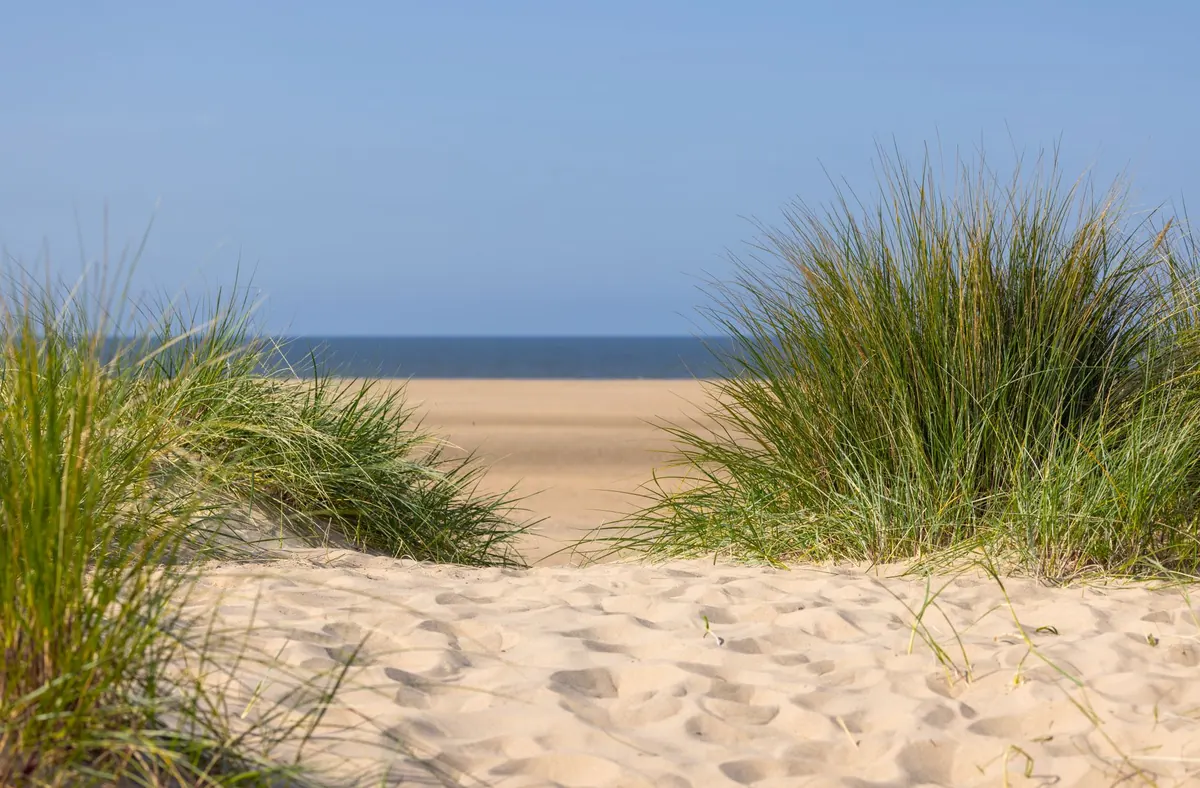
Marram grass (Ammophila arenaria) is the most familiar dune builder in the UK. Look for dense, stiff tussocks of grey-green leaves on the seaward side of the dunes. The leaves are long, narrow, and rolled inwards, so they feel tough and wiry rather than soft. The tips can be sharp, so run a finger along the blade carefully. In late summer, marram sends up a pale, spike-like flower head that turns straw-coloured as it seeds.
The real work happens below ground. Marram spreads by tough rhizomes that run through the sand. When sand buries the plant, it responds by growing upwards, trapping more sand in the process. That is how a foredune grows. If you gently brush sand away from a tussock, you may see the pale, woody rhizomes. Do not dig them up; just look and then let the sand settle back.
Lyme grass and sea couch: the front line
Lyme grass
Lyme grass (Leymus arenarius) is bigger and bluer than marram. Its leaves are broad, flat, and blue-green, often with a slight grey bloom. It grows in loose clumps on the upper beach and the very front of the dunes. The flower head is a stout, wheat-like spike, larger than marram’s. Lyme grass is a pioneer: it catches sand at the strandline and helps start the dune-building process.
Sea couch
Sea couch (Elytrigia juncea) is wiry and understated. Its stems are tough and often bend upwards from the sand, and its grey-green leaves are narrower than lyme grass. It tends to sit lower on the beach, often where the sand is still being moved by wind and tide. Like marram, it spreads by rhizomes, but it is less likely to build tall dunes. Instead, it holds the sand in place long enough for other plants to arrive.
Sand sedge, red fescue and the quiet binders
Once the sand stops moving, the plant community changes. Marram becomes less dominant, and finer, less spectacular plants take over. They are the quiet binders that turn yellow dune into grey dune.
- Sand sedge (Carex arenaria): a stiff, grass-like plant with creeping rhizomes that run just below the surface. Its leaves are arranged in three ranks, giving it a slightly flattened look. It often forms long, loose lines across the sand.
- Red fescue (Festuca rubra): a fine-leaved grass, often with a reddish or purplish tinge at the base. It forms dense tufts and helps bind the surface once the sand is stable.
- Kidney vetch, bird’s-foot trefoil, and wild thyme: not dune builders in the same way, but they appear on fixed dunes and add nitrogen or cover that supports a wider community.
These plants do not trap sand as aggressively as marram. Their role is to hold what is already there, build organic matter, and create the conditions for mosses and lichens.
Mosses, lichens and the grey dune crust
On older dunes, you will often see a patchy crust of mosses and lichens on the sand surface. Mosses such as Tortula and Syntrichia species form low, star-like cushions, while lichens like Cladonia species send up tiny, pale cups or branches. This crust is easy to miss, but it is important. It reduces wind erosion, holds moisture, and adds organic matter as it grows and dies back.
Walk carefully here. A single footprint can break a crust that took years to form. If you want to look closely, kneel or use a hand lens rather than scraping the surface.
Field tips: how to identify with confidence
Identification is easier when you combine habitat, habit, and a few close-up details. Use this order:
- Check the zone. Are you on the upper beach, a yellow dune, a grey dune, or a dune slack? That immediately rules out some species.
- Look at the leaves. Are they rolled and wiry (marram), broad and blue-green (lyme grass), or fine and reddish (red fescue)? Roll a leaf between your fingers to feel the texture.
- Check the flowers or seed heads. Marram has a pale spike; lyme grass has a stout wheat-like head; sea couch has a slender, nodding head.
- Look at how it grows. Dense tussocks, loose clumps, or long creeping runners? Rhizomes are a clue, but do not dig them up.
- Use a field guide. A vegetative key or a local wildlife trust guide can help with tricky grasses.
Take photographs from several angles, including a close-up of the leaf and the whole plant in its setting. A record of the location and date is more useful than a perfect identification if you are contributing to a local survey.
Tread lightly and keep learning
Dune plants are tough, but dunes are fragile. Marram can survive being buried, yet it cannot survive being trampled into a bare path or pulled up for a closer look. Stay on established paths where they exist, keep dogs from digging in the foredune, and leave flowers and seed heads to set seed. If you are recording species, a notebook and a hand lens are enough. The more you visit the same dune system through the year, the more you will notice: marram greening up in spring, sea couch holding the strandline, and the quiet shift from yellow sand to grey, fixed ground. That slow change is the work of plants, and once you can name them, you can see it happening.
Photo: Victoria Bowers / Pexels